English
Fandt du ikke et produkt, der passer til dig?
Kontakt os for de seneste nyheder.

Shocks and suspension get used interchangeably in everyday conversation, but they describe two very different things. One is a complete system; the other is a single component within it. Treating them as synonyms leads to misdiagnosed problems, wrong replacement parts, and a lot of unnecessary confusion at the repair shop.
The suspension system is the entire network of components that connects your vehicle's wheels to its frame — springs, shock absorbers, control arms, bushings, anti-roll bars, and more. Shock absorbers (commonly called "shocks") are just one piece of that network. Every vehicle has a suspension system. Not every suspension system uses the same type of shock absorber. That distinction is worth understanding before you spend money on repairs.
A vehicle's suspension system does three jobs simultaneously: it supports the weight of the vehicle, absorbs energy from road imperfections before it reaches the cabin, and keeps the tires in firm contact with the road surface at all times. Lose any one of those three functions and you have a handling problem — or a safety problem.
The main components that make up a suspension system include:
Remove or neglect any of these parts and the system fails as a whole — even if the shock absorbers themselves are perfectly fine. That's why a complaint like "my ride feels rough" can point to a worn spring just as easily as a failing shock. For vehicles operating under heavy loads, such as commercial trucks, this interdependence matters even more. Properly engineered suspension shock absorbers designed for commercial vehicles must account for the full system load, not just the damping requirement in isolation.
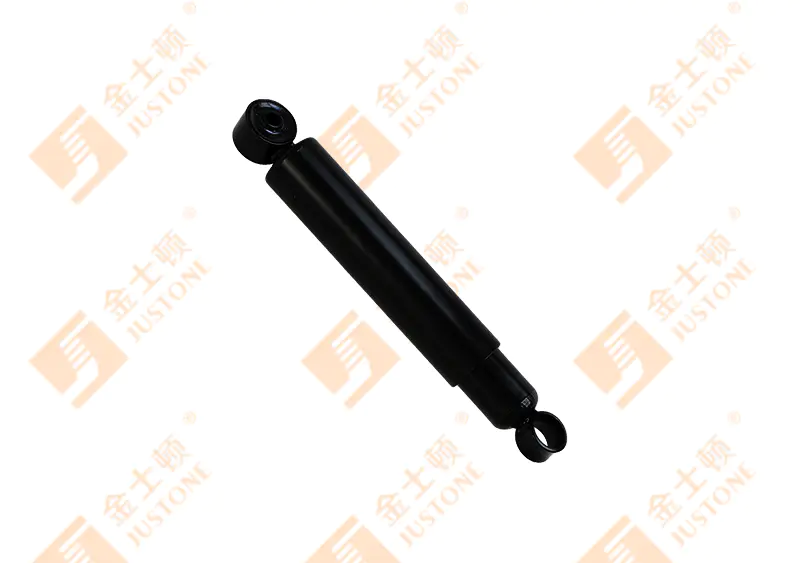
A shock absorber is a hydraulic damping device. Its job is not to absorb the initial shock — that's what the spring does — but to control what happens next. After a spring compresses over a bump and releases that stored energy, the shock absorber prevents it from bouncing back repeatedly. It does this by forcing oil through small orifices inside a sealed cylinder, converting kinetic energy into heat that dissipates into the surrounding air.
The faster the suspension moves, the more resistance the shock provides. This velocity-sensitive response is what allows a shock absorber to handle a shallow pothole and a sharp railroad crossing very differently — automatically, without any driver input. For a deeper look at the hydraulic mechanics behind this process, see what a shock absorber is and how it functions.
Shocks are not structural. They do not support the weight of the vehicle — the springs do that. A car with failed shock absorbers can still be driven, though poorly. A car with broken springs cannot support itself at all. According to AAA's breakdown of how shocks and struts differ, shocks are individual components of the suspension system while struts are a major structural element of the chassis itself — a distinction that affects both repairability and replacement cost.
| Feature | Shock Absorber | Strut |
|---|---|---|
| Structural role | None — damping only | Yes — part of chassis structure |
| Supports vehicle weight | No | Yes (contains spring) |
| Affects wheel alignment | Minimally | Directly |
| Space required | More (separate spring needed) | Less (spring integrated) |
| Replacement complexity | Lower | Higher |
| Common on | Rear axles, heavy trucks, trailers | Front axles, front-wheel-drive cars |
In heavy commercial vehicle applications, standalone shock absorbers remain the dominant choice because the structural loads involved are too great for strut-type assemblies. Heavy truck chassis shock absorbers are engineered specifically to handle these demands, with damping characteristics tuned for variable loads and extended operating cycles.
The terminology problem has several roots. In casual speech, mechanics and drivers alike often say "shocks" when they mean the entire suspension system. Phrases like "I need new shocks" frequently turn out to mean "my ride has deteriorated" — which could involve springs, bushings, or struts rather than shock absorbers at all.
Struts add another layer of confusion. A strut performs the same damping function as a shock absorber but also replaces the upper control arm and acts as a structural pivot point for the steering. Many front-wheel-drive passenger cars use struts up front and conventional shocks at the rear. Ask two drivers about their "shocks" and one might be referring to struts while the other is describing traditional shock absorbers — and both are technically part of the suspension system.
It's also worth noting that shock absorbers are not exclusive to vehicle wheel suspension. Non-suspension shock absorber applications include cab mounts, seat dampers, trailer hitches, and industrial equipment — contexts where the damping function is needed but where no traditional suspension system exists. This versatility reinforces the point: a shock absorber is a tool that can be deployed inside or outside of a vehicle suspension.
Because the suspension system has multiple components, symptoms of wear don't always point cleanly to one part. That said, some patterns are worth knowing.
As a general rule, shock absorbers on passenger vehicles should be inspected every 50,000 miles. Commercial and heavy-duty applications require more frequent checks due to the additional stress of load variation and road conditions. Understanding how the full system behaves under load is essential — the role of the suspension system in a heavy truck chassis, for instance, extends well beyond ride comfort to include load distribution, cargo protection, and braking stability. For a detailed breakdown of those responsibilities, see how the suspension system functions in a heavy truck chassis.
If you're unsure whether you're dealing with a shock absorber problem or a broader suspension issue, the safest approach is a full inspection rather than replacing individual parts blindly. The two systems are connected — and a fix that addresses only one component may leave the underlying cause untouched.
Kontakt os for de seneste nyheder.
Copyright @ Hangzhou Justone Industry Co., Ltd.
 OEM-fabrikanter af støddæmpere til erhvervskøretøjer
Engros bilstøddæmperfabrik
OEM-fabrikanter af støddæmpere til erhvervskøretøjer
Engros bilstøddæmperfabrik